Adapting in an Evolving City
President Gary Johnson evaluates early 20th century office buildings and how those buildings can be effectively reused in cities like Boston to accommodate post-COVID needs.
President Gary Johnson evaluates early 20th century office buildings and how those buildings can be effectively reused in cities like Boston to accommodate post-COVID needs.
CambridgeSeven’s (slightly-biased) list of adventures and excursions for you and your loved ones to do this holiday season!
Modern sports museums and exhibits are moving beyond the game to highlight academic subjects such as physics, women’s studies and history within their experiences.
Using bio-positive design to create opportunities that support flora and fauna at the ocean’s edge also create resilient and educational waterfront sites.
How aquariums are making their conservation and sustainability actions the theme of exhibits and vital components of their architecture.
How aquariums are using their public presence to influence change for good and promote ocean conservation globally.
While at the Design for Freedom Summit at Grace Farms, we learned five big steps architects can take to make better material choices.
2023 CRLS graduate Kidus Desalegn is the sixth annual winner of the CambridgeSeven STEAM scholarship award.
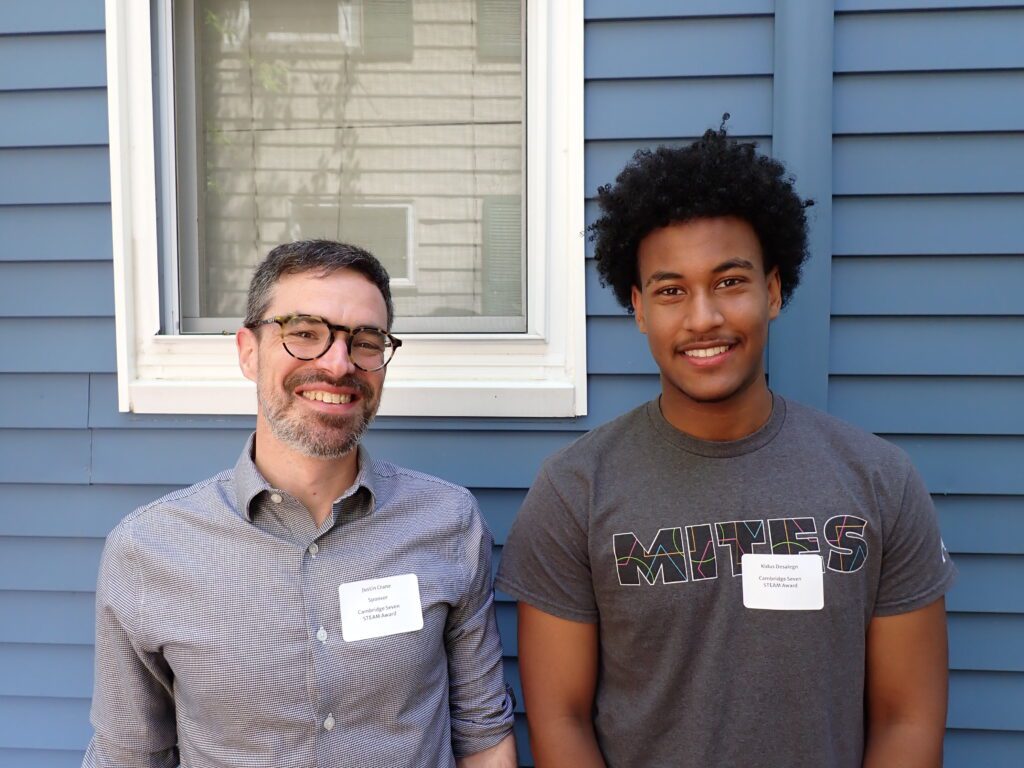 CambridgeSeven, the Cambridge, MA-based architecture and design firm, announced the winner of its sixth annual STEAM scholarship for students of Cambridge Rindge and Latin School (CRLS). The 2023 award recipient, Kidus Desalegn, graduates from CRLS in June of 2023 and will attend Northeastern University in the Fall, where he will study Computer Science/Mechanical Engineering with a goal of pursuing a career in Computer Science and Robotics.
Kidus was selected for the scholarship due to outstanding academic achievement throughout his high school tenure, his student leadership skills, and for showing a passion for AI robotics and computer science. Kidus was a member of the MIT MITES (Minority Introduction to Engineering and Science); acted as President and Co-Founder of the Cybersecurity Club – a hobby that he turned into an after-school club to bring together other students with similar interests, and was a member of the Architecture, Construction, and Engineering (ACE) Mentors. In addition, he was a member of the Prison Justice Club, the National Honor Society (NHS), and the Pan Asian Club. Kidus also demonstrated a passion for volunteer activism, donating 90 hours to the community by volunteering at the Cambridge Science Festival, the Charles River cleanup, and additional community activities. Kidus’ special passion is dance. Having grown up listening to Ethiopian music and practicing the national dance, Eskista, in his native country, Kidus brought this electrifying and joyful part of his culture with him when he immigrated to the United States.
“We are thrilled to award our 6th Annual STEAM Scholarship to Kidus,” said Justin Crane, FAIA, Principal at CambridgeSeven. “Since its inception, CambridgeSeven has sought to transform communities – not only through purposeful design, but by actively engaging with young minds to spark interest in the STEAM fields so that the next generation of professionals more accurately reflects our everyday world. It has been our honor to partner with the Friends of Cambridge Rindge and Latin School to invest in students’ higher education.”
CambridgeSeven began its partnership with the Friends of Cambridge Rindge and Latin School in 2018, to provide an annual STEAM Scholarship Program for students at CRLS. This program grants a $5,000 scholarship to a deserving senior pursuing a college education in one of the STEAM fields: Science, Technology, Engineering, Arts and Mathematics. To qualify for this scholarship, the student must be the first in their family to attend a 4-year college, a full-time student working towards an undergraduate degree at an accredited college or university, and committed to excel in one of the STEAM fields.
Previous scholarship winners include Emie Gerard, 2022, currently attending the Rochester Institute of Technology (RIT) where she was accepted into the Combined Accelerated Bachelor’s/Master’s Degree program; Greggy Bazile, 2021, majoring in architecture at Cornell University’s School of Architecture, Art and Planning; Jaadyyah Shearrion, 2020, pursuing a computer engineering degree at Boston University; Sagyan Aryal, 2019, a 2023 computer science graduate of UMass Amherst Honors College; and Soliana Yebio, 2018, a graduate of UMASS Lowell 2022 with a Bachelor’s degree in Public Health and Business.
About CambridgeSeven
Architecture firm CambridgeSeven was formed by seven visionary architects, designers and artists who created a partnership born of a sense of doing what’s right not only for clients, but for public spaces. From the precedent-setting design of the New England Aquarium on Boston’s waterfront in 1969, to the 2022 transformation of a 19th Century industrial building in Cambridge’s Kendall Square into The Foundry, a center for community arts and performance, CambridgeSeven’s fresh, thoughtful, design solutions transform communities through shared discovery and purposeful architecture. Celebrating its rich legacy over six decades of designing museums, aquariums, hotels, academic and civic spaces across the globe, CambridgeSeven is committed to designing for the future through sustainable buildings and built environments, equitable design that is culturally relevant and empowering communities to contribute to positive change.
About FOCRLS
Friends of Cambridge Rindge and Latin School (FOCRLS) is a 501(c)3 tax-deductible non-profit high school-community association. The mission is to develop, support, and enrich the academic and social development programs at Cambridge Rindge and Latin School and to support the alumni of CRLS and its predecessor schools. FOCRLS promotes achievement and a greater community investment in the future of CRLS, its current students, and its graduates. For more information visit http://focrls.org/.