Evolution of the Sports Museum: Exhibits off Limits No More
A timeline look at how sports museums have evolved over the past four decades with technology and cultural shifts.
View Post
The question that ignited my career came during my thesis at Cooper Union: What if museums could break free from their traditional constraints? By approaching this idea from both an artist and architecture lens, I challenged the Beaux-Arts model of sequential galleries that had dominated museum typology for centuries. The Pompidou Centre had already proven that radical rethinking was possible, demonstrating how physical space could be designed around the artwork it houses rather than forcing collections into predetermined galleries.
This investigation into alternative museum spaces revealed a fundamental truth: the relationship between space and artifact is not fixed but fluid, waiting to be reimagined with each collection and revealing the story to be told.
Sports heritage presents unique collections that demand this alternative thinking. When we completed the exhibits at the New Balance Track in 2022, we weren’t simply installing artifacts along a 150-foot timeline. We were telling the story of track and field’s deep roots in New England, embedding historical objects within the building’s trusses themselves. The architecture didn’t just house the history, it highlighted the narrative.
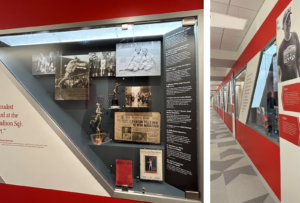
This approach transformed what could have been a utilitarian space into an immersive journey through time, where visitors experience the evolution of the sport as they move through the building. The corridor proves that sports heritage doesn’t require traditional gallery walls; sometimes the most powerful museum is the path you’re already walking.
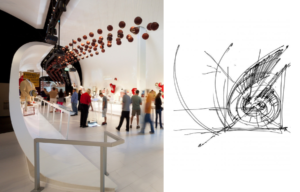
The best sports exhibits begin not with objects but with moments. For the San Francisco 49ers Museum, we started with pivotal plays that defined championships and careers. Footballs suspended in cubist arrangements imply motion and frozen time simultaneously. At the Patriots Hall of Fame, each artifact becomes more than itself: a uniform transforms into an action figure representing “Anatomy of a Comeback” or “Anatomy of a Catch.”

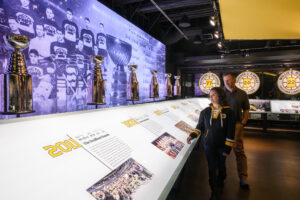
The story dictates how artifacts are displayed, which moments receive emphasis, and how visitors navigate the timeline. When designing the Boston Bruins centennial exhibit, we faced the challenge of condensing 100 years into 70 feet. Rather than attempting encyclopedic coverage, we elevated select defining moments. Every 25 years warranted an artifact case, and the layout itself told a story: working right to left, then turning into an L-shaped hockey stick configuration. The space narrows and then widens, creating a crescendo effect that builds toward a trophy extravaganza of Stanley Cups.
Not every sports story follows a chronological timeline. Sometimes the most compelling framework is values-based. At the Bruins Heritage Hall, we organized exhibits around passion, grit, tradition and heart, and created cases that showcased not just what the team accomplished but why those achievements mattered.
Traditional museums maintain separation between viewer and object. We remove this barrier wherever possible, either through technology or through physical interaction. Touchscreens allow visitors to manipulate artifacts they cannot physically handle. Transparent OLED displays diffuse the distance between observer and observed, creating intimacy with the historical objects. When we integrate media with artifact storytelling, we’re not replacing the physical with the digital, but we’re expanding ways to engage the fans.

We also prioritize three-dimensional display whenever possible, though we frequently manipulate artifacts – orienting, lighting, or contextualizing them – to serve the larger narrative. The artifact must fulfill the story, not simply occupy space.
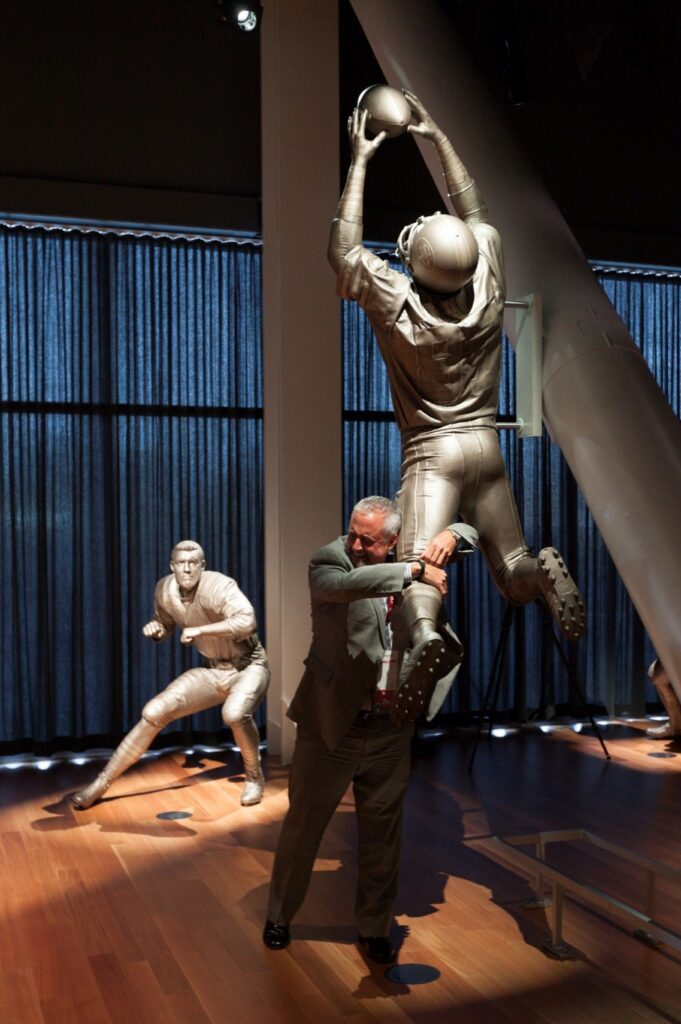
The most radical departure from traditional museum practice comes when we invite direct interaction. At the interactive player theater at the San Francisco 49ers Museum, life-sized bronze statues play together in a single room, each capturing an iconic athlete in their defining moment. These aren’t monuments to be viewed from a distance -they’re encounters waiting to happen and fans often (literally) embrace this experience. This is the power of alternative museum spaces: they don’t just preserve sports heritage, they make it present, tangible, and alive.
CambridgeSeven continues to evolve museum typology in sports heritage exhibit design and create experiences that honor both artifact and audience. We remove barriers, invite touch and recognize that the most powerful experiential design dissolves the boundary between observer and observed, between past achievement and present inspiration.
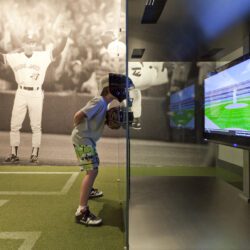
A timeline look at how sports museums have evolved over the past four decades with technology and cultural shifts.
View Post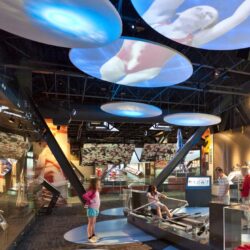
Modern sports museums and exhibits are moving beyond the game to highlight academic subjects such as physics, women's studies and history within their experiences.
View Post
Learn seven ways to renovate, modernize, and improve existing museums and visitor attractions no matter what your subject matter is!
View Post