Architects have always worked with tools. We moved from hand drafting to CAD, from CAD to BIM, from static renderings to real-time engines. Each shift reshaped our workflows. AI is the newest shift, and it may be the biggest one yet. We’ve been using AI tools in architectural practice long enough now to feel two things at the same time: excitement and unease. Midjourney and Nano Banana can generate concept imagery in seconds. ChatGPT can draft meeting minutes, RFIs, and narratives faster than we can type. The acceleration is real and it’s affecting the daily rhythm of practice. But the more I use these tools, the more convinced I become of something that might sound surprising: AI doesn’t make architects less important. It makes the role of architects more important and more visible. Here are five things I’ve learned from using AI in practice, with examples from the tools shaping our workflows.
1) Generative AI Images: Stable Diffusion, Midjourney & Nano Banana
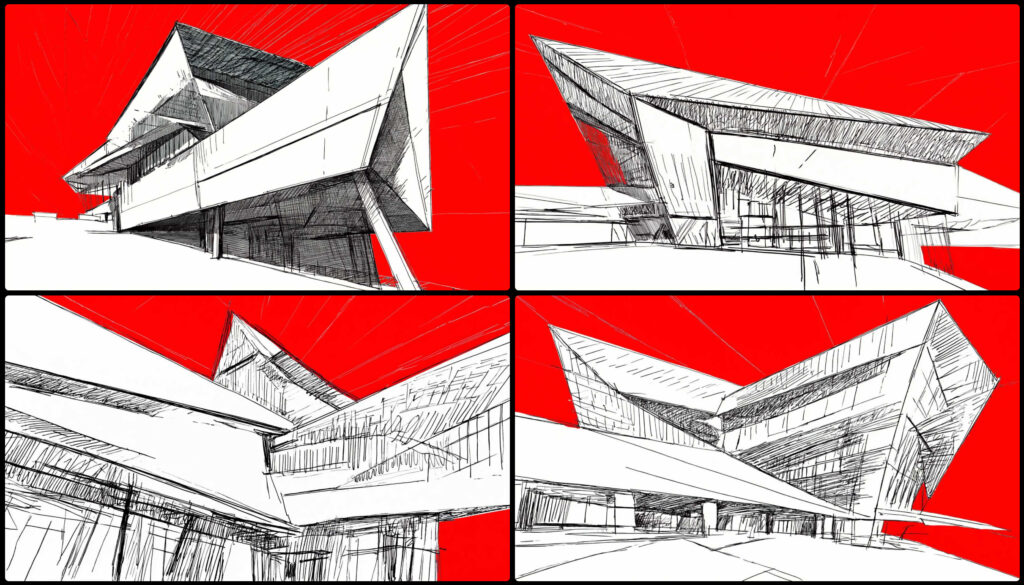
The first place I felt AI truly change my day-to-day workflow was in generative imagery. With Stable Diffusion, Midjourney, and lately Nano Banana, I can explore geometry, materiality, and atmosphere at a speed that would have been beyond my imagination even a few years ago. What once took a week of manual iterations to suss out design issues now can be almost instantaneous, freeing up our creative process to explore more ideas and deliver stronger design solutions. In many ways, AI has turned early conceptual design into something closer to editorial work: architects are no longer only makers, but also curators and editors, and our time is now more valuably spent exploring better solutions.
Tech Stack:
Stable Diffusion, Midjourney, or Nano Banana
ChatGPT
Adobe Photoshop
AI-generated Concept Sketches
Successful collaboration: Generative AI becomes incredibly effective when architects use it as a rapid concept sketchbook. We test multiple design narratives quickly, communicate moods to clients who struggle to read drawings, and align a team around a direction early. Used this way, Midjourney and Nano Banana can shorten weeks of ambiguity into a single productive conversation.
Failure mode: Sometimes it takes longer to generate the “right” AI image than it would have taken to simply sketch, model, and render the idea directly. Without architects steering the process, teams can get trapped in endless prompt iteration – producing dozens of images that may be visually impressive but not aligned with the actual design problem and even nonsensical.
2) Bringing still images to life: Adobe Firefly
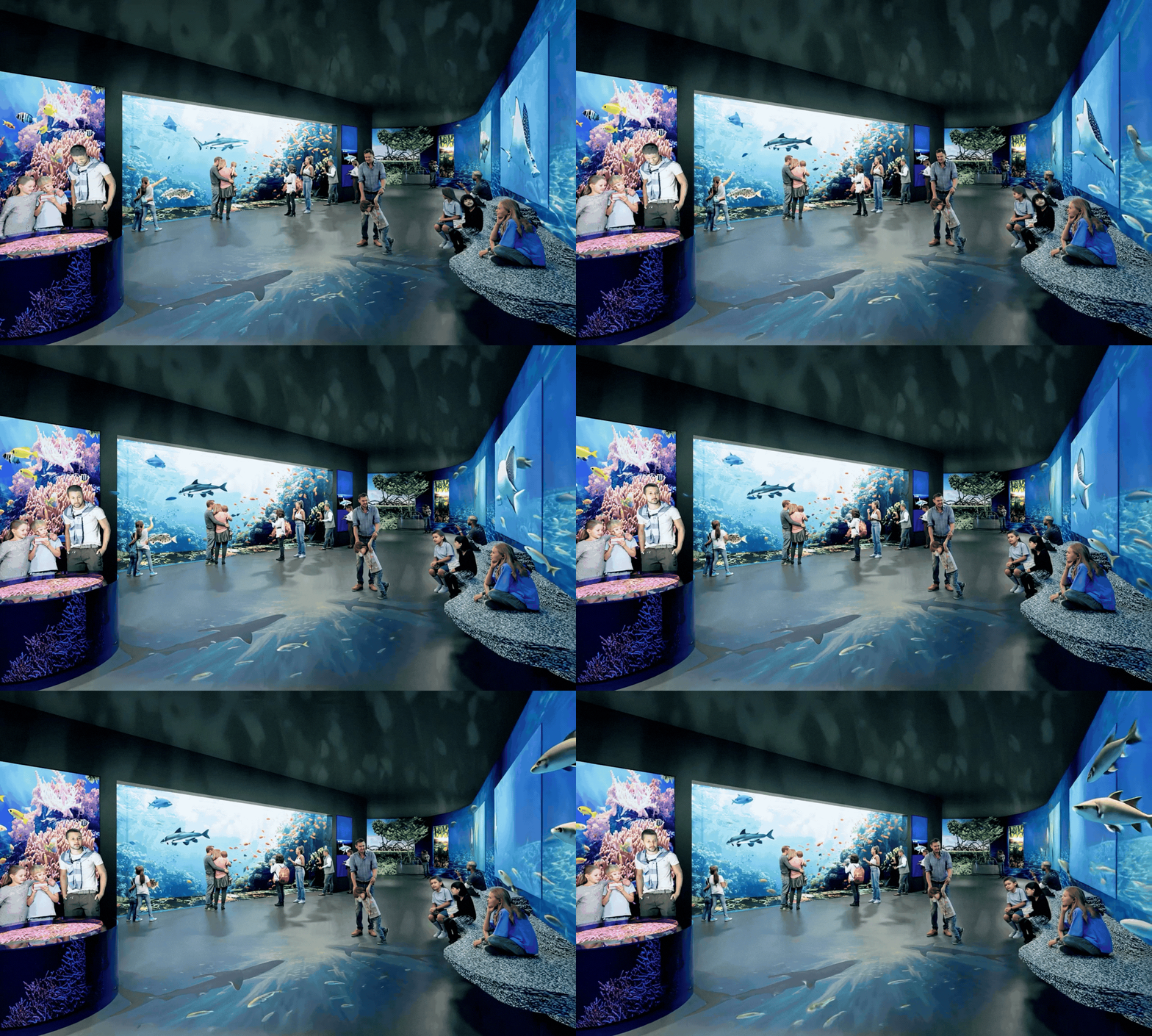
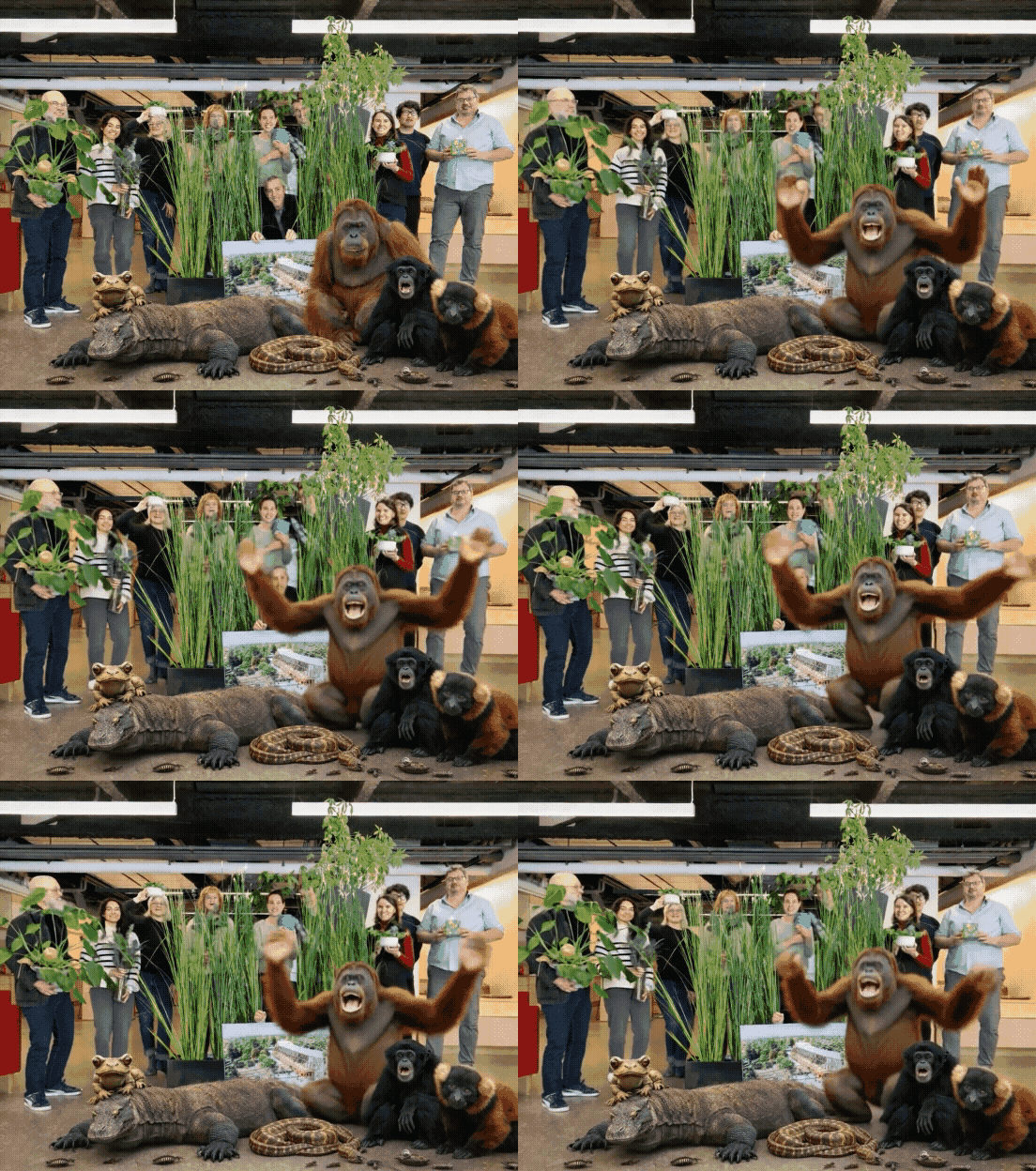
Architectural renderings produced in Revit and Enscape (or Lumion) already offer high-quality, photorealistic visuals with control over materials, lighting, composition, and context. But they are typically static snapshots and static images can limit how clients and stakeholders emotionally engage with a design. By integrating AI-driven animation tools like Adobe Firefly, movement and atmosphere add an emotive aspect to the renderings, transforming a single image into a cinematic experience. A project can become more legible and more compelling not because the design changed, but because the story became clearer. We’re using these tools to captivate the mood and experience that our designs work to create.
Tech Stack:
Autodesk Revit
Chaos Enscape or Lumion
Adobe Firefly
Adobe After Effects
Successful collaboration:
Firefly works best when architects use it not to fabricate reality but to enhance communication, such as applying subtle movement to convey time-of-day, weather, season, and the lived atmosphere of a space. It can be a powerful bridge between design intent and client understanding, especially in marketing, interviews, and early stakeholder buy-in.
Failure mode: Without architects guiding the workflow, AI animation can quickly become a technical trap. Firefly motion often struggles with architectural precision: mullions can warp, edges can shimmer, glass reflections can behave inconsistently, and repeated patterns (like curtain wall grids) can “crawl” frame-to-frame. Even small hallucinations become obvious because our eyes detect straight lines, alignment, and scale. And sometimes these errors are simply surreal (people walking backward, shadows moving the wrong way, or trees behaving unnaturally) and once those errors appear, they can be surprisingly difficult (or practically impossible!) to correct without rebuilding the sequence from scratch. As a result, teams can end up spending more time fighting flicker, distortion and continuity errors than they would have spent producing a simple, clean camera animation in Enscape or Twinmotion. The output may look dynamic, but the process becomes unpredictable and the time savings disappear.
3) Accelerated data analysis: Autodesk Forma + Finch
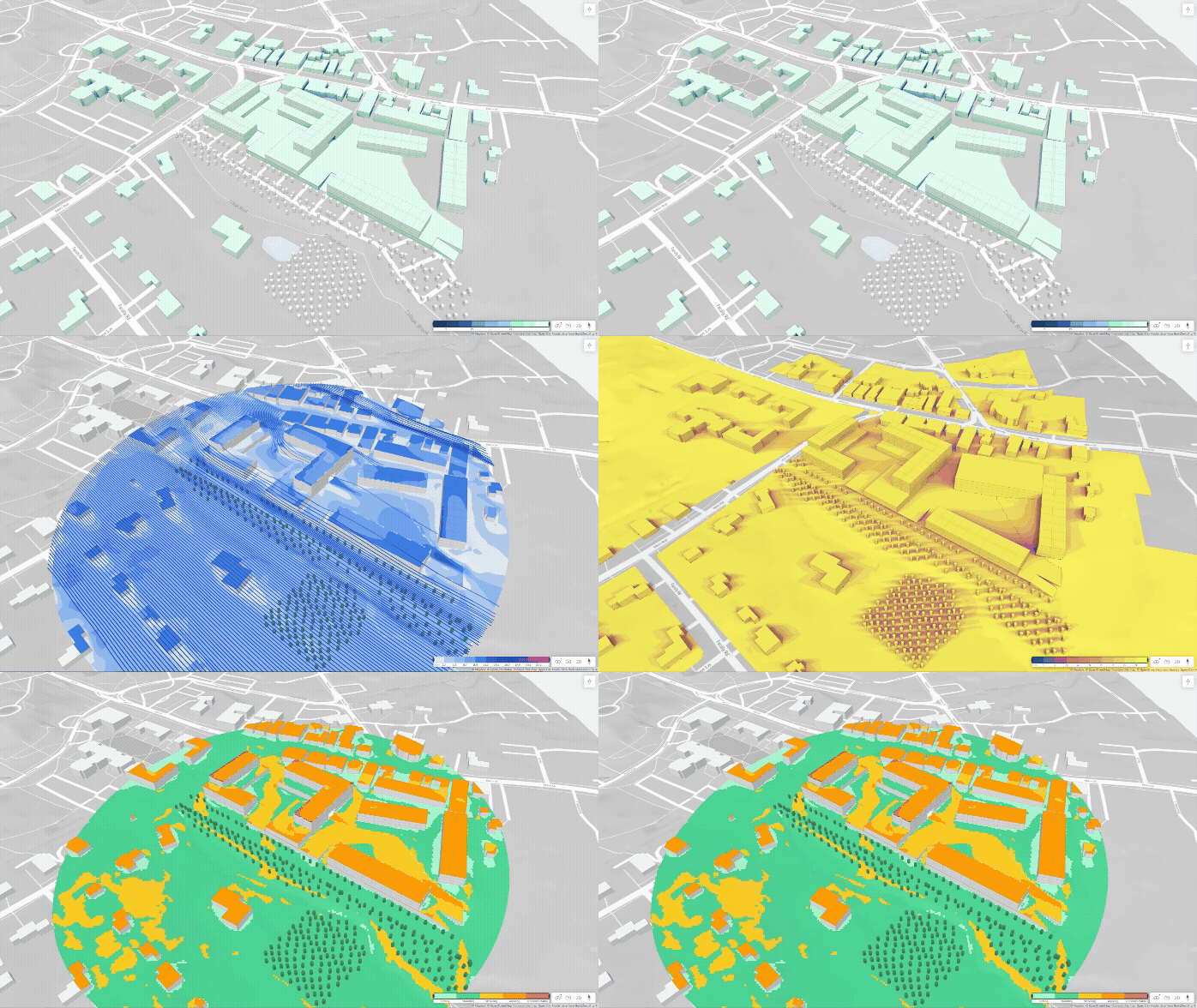
AI is not only changing how we visualize design, it’s also changing how we evaluate it. Tools like Autodesk Forma make early-stage analysis faster and more accessible, allowing architects to test massing and site decisions with daylight, wind, and environmental feedback early in concept design. At the same time, planning-focused tools like Finch push this even further by generating floor plans instantly, allowing teams to explore multiple planning and test-fit scenarios in minutes instead of days. This is one of the most promising applications of AI in practice: it allows for feasibility, planning, and performance thinking at the earliest phases when decisions are being strategized. It allows architects to bring evidence into the conversation sooner, not as an afterthought, but as a design driver. This is another example when architect involvement really matters because analysis is not the same as judgment. Autodesk Forma and Finch can tell you what performs better numerically or fits more efficiently, but they cannot tell you what is culturally appropriate, socially generous, or emotionally right. Architects are responsible for translating data into design decisions that are meaningful, practical, and rooted in lived experience.
Tech Stack:
Autodesk Forma
Finch
Autodesk Revit
Daylight Potential, Sun Exposure, Wind Comfort, and Wind Direction Analysis
Successful collaboration: Autodesk Forma and Finch are most powerful when architects treat them as feedback loops to test early massing, feasibility, and planning ideas quickly, compare options transparently, and make performance part of the initial design language rather than a late-stage correction. They support better decision-making and help architects communicate tradeoffs clearly to clients and stakeholders.
Failure mode:
Without architects steering the process, Autodesk Forma and Finch can create a false sense of certainty especially when early-stage assumptions are overly simplified or just wrong. Concept models often rely on generic material properties, default occupancy profiles, simplified geometry, and raw environmental data. If those inputs aren’t carefully defined, inexperienced teams may optimize toward an option that performs well in the dashboard but fails under real design conditions later. At the same time, because these tools make analysis and test-fitting so fast, they can tempt teams to chase performance feedback before the architectural idea is even formed. Instead of analysis refining design, the design can become a byproduct of the tool and an aberration of form following function.
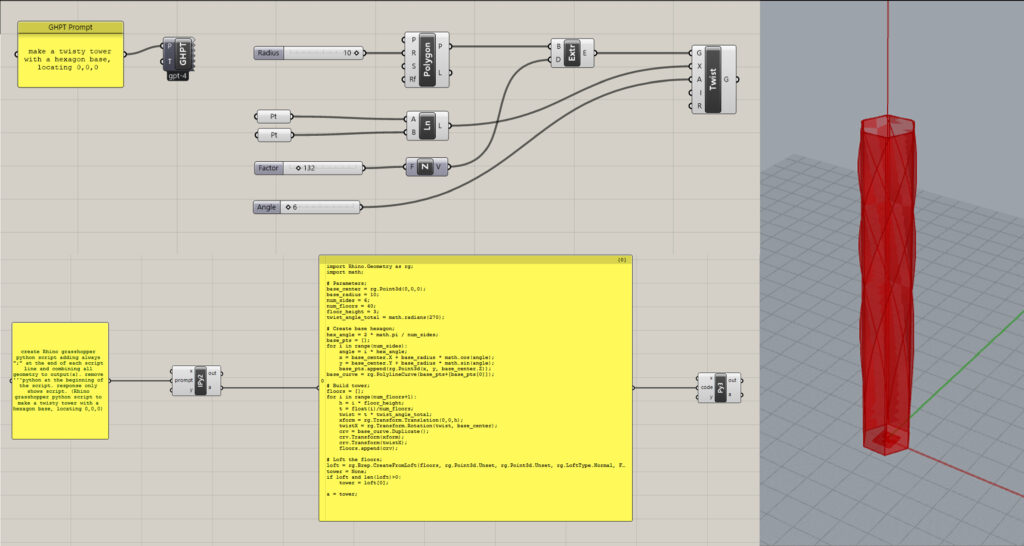
Grasshopper is one of the most powerful tools in architectural practice, but it comes with familiar challenges: a steep learning curve, time-consuming workflows, and limited flexibility for designers who aren’t comfortable scripting. AI is beginning to change the equation by making parametric thinking more accessible and faster to prototype. Several distinct approaches have emerged for integrating ChatGPT with Grasshopper workflows, including GHPT, IronPython, and Raven. The GHPT component enables users to generate full Grasshopper definitions from natural language prompts. IronPython (Python 3 pipeline) allows dynamic AI-assisted coding directly inside Grasshopper, giving designers a faster way to write, debug, and refine scripts while staying in the modeling environment. Raven takes a more visual workflow approach: it helps users build and modify Grasshopper definitions through an AI-assisted interface, making it easier to generate components, wire logic, and iterate on parametric systems without starting from a blank canvas. In the best scenarios, AI becomes a translator by converting architectural intent into computational logic. It reduces friction and accelerates iteration, so more team members can participate meaningfully in parametric workflows.
A twisty tower model generation with GHPT Component Prompt-Driven Grasshopper Workflow Generation & IronPython+ChatGPT to Python 3 Script Pipeline
Tech Stack:
Rhinoceros 8.0
Grasshopper
ChatGPT 4.1
GHPT
IronPython 2
Python 3
Raven
Successful collaboration:
AI becomes a genuine accelerator when architects use it to prototype geometry logic quickly, automate repetitive tasks, generate clean script scaffolding, and troubleshoot faster. It enables architects to focus on higher-level thinking like what the parameters should be, what the constraints represent, and what the design is trying to achieve.
Failure mode: AI-generated Grasshopper and Python scripts often work “once,” but they’re fragile. They can break as soon as inputs change or geometry gets messy or a teammate tries to reuse the definition. Without architects enforcing clean structure, naming conventions, documentation, and basic testing, the workflow quickly accumulates debugging debt and any time saved upfront gets paid back later.
5) Façade optimization and rationalization: Rhinoceros, Grasshopper, Ladybug, Galapagos
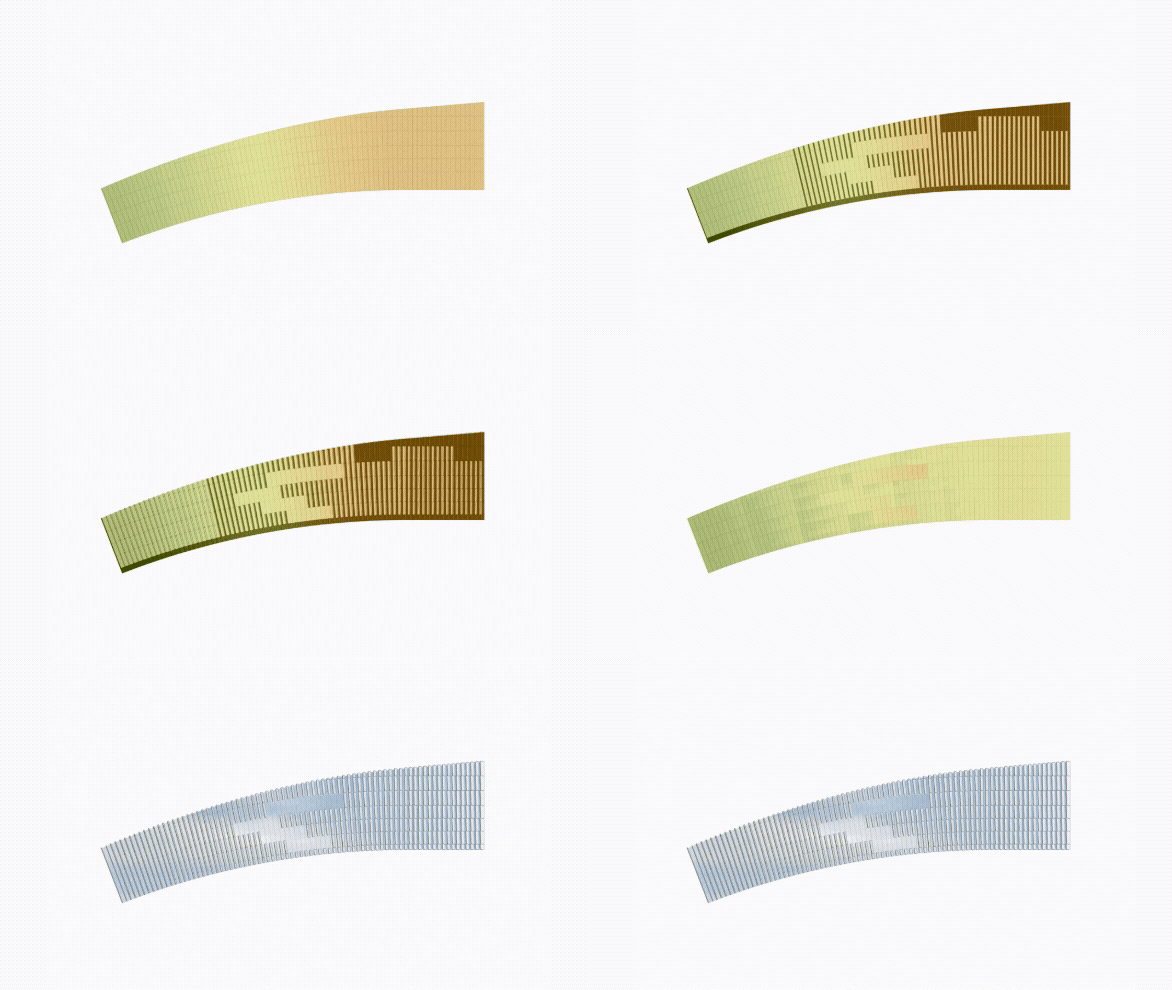
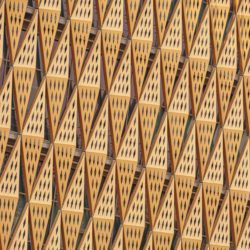
For the Roux Institute at Northeastern University’s Alfond Center project, we developed a data-driven workflow to balance competing factors such as window-to-wall ratio, glare control, view preservation, and solar radiation within a unified façade system. Our initial design prioritized panoramic views of Portland’s Casco Bay, featuring a fully glazed façade to celebrate the site’s unique location. But detailed performance analysis revealed significant downsides: excessive glare and solar heat gain that compromised both occupant comfort and energy efficiency. To address this, we built parametric scripts in Rhinoceros and Grasshopper, introducing external shading fins and fine-tuning façade transparency based on environmental performance.
The Roux Institute at Northeastern University’s Alfond Center Solar Radiation Benefit Optimization Process
Using Ladybug tools, we tested solar exposure and comfort metrics and found that a 60:40 window-to-wall ratio struck the ideal balance that reduces energy loads while preserving spatial transparency. From there, we employed Galapagos, an evolutionary solver inside Grasshopper, to generate hundreds of permutations and optimize the façade layout. This process precisely positioned opaque and transparent zones to maximize beneficial solar radiation while minimizing glare and discomfort. The result was highly performant, but it introduced a real-world problem: this optimized façade recommendation would require 527 unique curtain wall units, driven by the building’s complex geometry. That’s where rationalization became critical. Using the Kangaroo plugin for physics simulations and systematic grouping logic, we reduced the system to just 9 distinct unit types per floor, without sacrificing design intent or performance. This is what successful AI collaboration looks like in architecture: not replacing design but expanding what design can yield.
Tech Stack:
Rhinoceros 8.0
Grasshopper
Ladybug
Galapagos
Kangaroo
Successful collaboration:
Machine learning and evolutionary solvers become powerful tools when architects use them as a tradeoff engine to explore the space between aesthetics, performance, and constructability. Tools like Ladybug and Galapagos allow architects to design architecture that is both visually bold and technically rigorous, while rationalization workflows keep the solution buildable.
Failure mode:
The hardest part often isn’t optimization – it’s rationalization. Once the algorithm produces hundreds of unique units, the real challenge is reducing complexity without destroying the architectural idea. Without architects guiding this step, rationalization can become pure value engineering: flattening the façade into repetition, erasing the subtle gradient or pattern that made the design meaningful in the first place.
Closing Thought
The more I use AI, the less I worry about whether architects will be replaced and the more I think about the value we architects bring. AI can make images faster, workflows smoother and options endless, but it cannot carry the burden of a real place. It cannot hold responsibility for what gets built, how it ages, or who it serves. In moments of disruption, I come back to a quote from Peter Pan (or Battlefield Galactica!):
“All of this has happened before, and it will all happen again.”
— J.M. Barrie, Peter Pan
Our tools will evolve, but the architect’s irreplaceable role providing discernment, care, and authorship will remain.
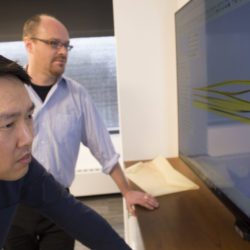
Timothy Mansfield, AIA, and Wonyeop Seok, AIA, discuss the new software and digital design tools used to create the breathtaking façade of the Roux Institute at Northeastern University in Portland, Maine.