An 1890 Steam-pump Manufactory Now Is a Vibrant Hub for the Cambridge, Mass., Community
From Steam to STEAM: The Foundry embraces its history within the new creative community hub
From Steam to STEAM: The Foundry embraces its history within the new creative community hub
James McCown of Metropolis magazine discusses the new creative, multi-purpose arts hub “The Foundry” with CambridgeSeven architects Justin Crane, FAIA, and Stefanie Greenfield, AIA.
Our First Fossil-Fuel-Free Fire Station will give firefighters of Somerville a comfortable reprieve where they can breathe easy.
CambridgeSeven is currently designing a net-zero public athletic pavilion at Danehy Park in Cambridge to serve local youth sports teams.
While at the Design for Freedom Summit at Grace Farms, we learned five big steps architects can take to make better material choices.
Industrial Building Joins Cambridge’s Innovation Economy. Written by Justin Crane.
The 50,000-square-foot former steam pump factory has gallery space, a black box theater, a dance studio, metal and fiber workshops, a kitchen, art studios, conference rooms and more — all available for public use.
Visitors are invited to explore galleries highlighting key discoveries and transformative insights in biomedicine.
Cambridge creatives have a new hotspot for artistic learning and collaboration: the Foundry in Kendall Square’s Innovation District.
CambridgeSeven celebrates the opening of the Foundry community center in Cambridge
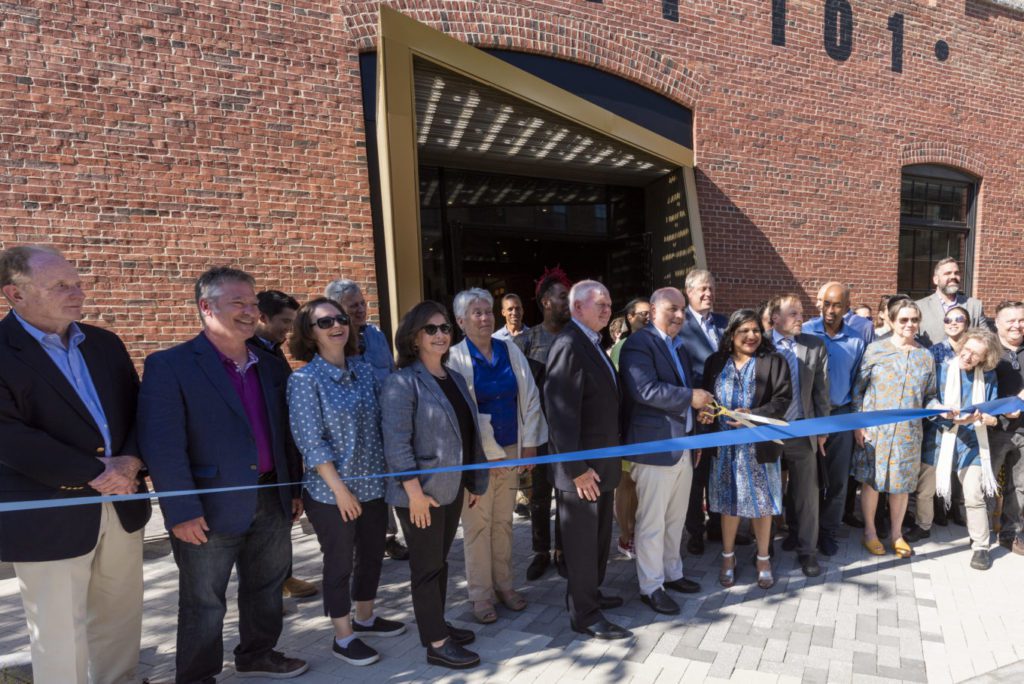
Cambridge creatives and artists will have a communal space to call their own in The Foundry 101 come early September.
Community leaders cut a big blue ribbon with oversized scissors on June 22, celebrating the $47 million adaptive reuse project’s substantial completion. The ceremony played out before a gathered crowd on a sprawling plaza that leads to the foundry’s front entrance.
The city acquired the 50,000-square-foot, historic foundry at 101 Rogers St. in 2012. Since 2015, the Cambridge Redevelopment Authority and the city collaborated on the capital project to transform the vacant building into an innovative, multi-purpose community center.
“In my 30-year career as an architect, I have never seen a public project like this one,” said CambridgeSeven principal architect Stefanie Greenfield, whose firm oversaw the capital project’s design. “This is the most unique building type that we have been engaged in. This building [now] houses a makerspace, culinary kitchen, textile and metalsmith workshop, a dance studio, an art gallery, and a performance theater — and it’s all open to the public.”
According to the Cambridge Redevelopment Authority, the newly renovated Foundry‘s specific features include but are not limited to:
Timothy Toomey, a former state representative and Cambridge city councilor, said the public building will serve as a unifying hub, bringing together East Cambridge and Kendall Square.
“As we work towards building a more inclusive Kendall Square, the foundry will set the stage for breaking down those barriers,” Toomey told the gathered crowd. “In the foundry, we have a place for the arts, a shared space for innovation and a vision to connect all members of the Cambridge community.”
The ribbon-cutting represents the culmination of many years of work, including the process of culling community input.
“It took seven years to get to this point,” said Elisa H. Hamilton. “The kind of community outreach that was done and the stakeholder inclusion showed that Cambridge wanted to do it right.”
She added, “They wanted this space to be a welcoming place.”
The city commissioned Hamilton to produce a series of Cambridge residents’ oral histories that will be displayed in the foundry. She has spent three years on the project entitled “Foundry Jukebox,” which will have a soft release on July 12 in the Cambridge Public Library from 5:30-7 p.m.
The Foundry Consortium, a nonprofit founded in conjunction with the capital project, will carry out a trio of duties: “Program management and outreach, property management, and, over time, sub-tenant recruitment and selection.”
The consortium endeavors to ensure the Foundry is self-sustaining and becomes a collaborative and thriving innovative center for visual and performing arts, entrepreneurship, technology and workforce education.
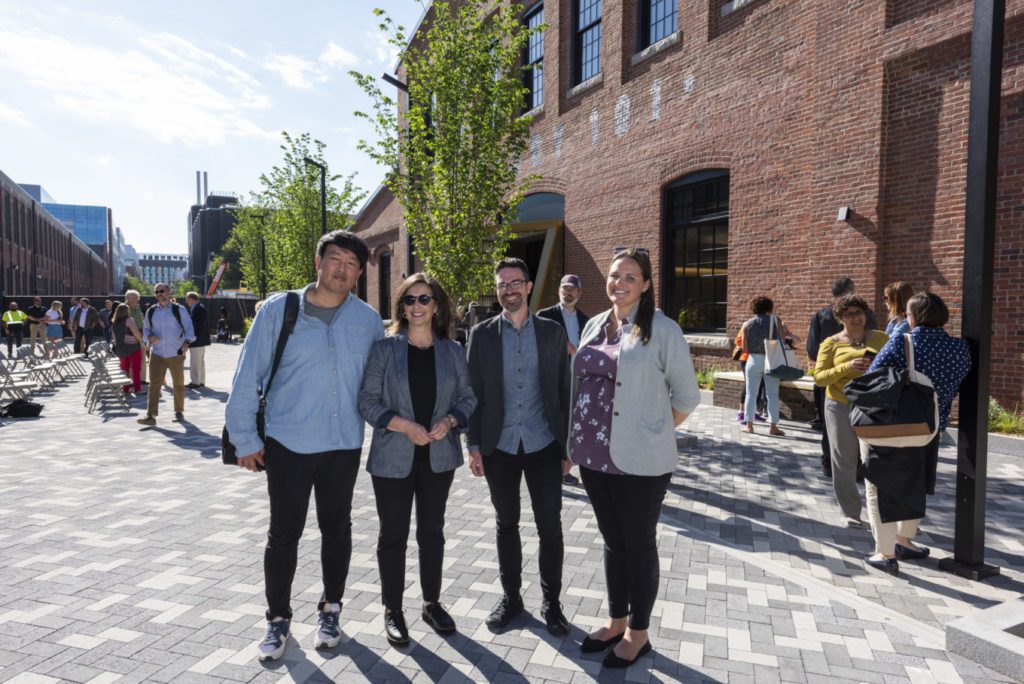
Charles Sullivan, Cambridge Historical Commission executive director, said the foundry sat in the very heart of a larger industrial complex for the Blake & Knowles Steam Pump Company.
“That included over 15 buildings on six blocks that employed 2,000 men and women to make industrial pumps,” said Sullivan, adding the pumps ranged in size from as small as suitcases to as large as vans. “On this side was a foundry for melting iron in temperatures of 2,800 degrees.”
According to the Cambridge Redevelopment Authority’s website, the foundry processed up to 50 tons of iron per day.
“Luckily, no one in Cambridge today has to work under those conditions of 2,800 degrees.”
The foundry shuttered in 1927, but over the years, it has had many different purposes: A taxi barn, auto repair shop and office building.