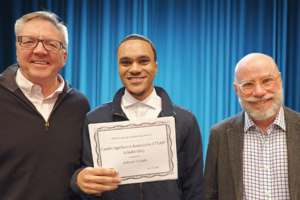
CambridgeSeven is proud to announce Jahmari Yakubu as the recipient of its 9th Annual STEAM Scholarship. A senior at Cambridge Rindge and Latin School (CRLS), Jahmari will pursue a degree in Construction Management at Franklin Cummings Tech this Fall, with plans to transfer to a four-year college.
“Each year, we have the privilege of meeting students who remind us why this scholarship matters, and Jahmari is a powerful example of exactly that,” said Timothy Mansfield, President, CambridgeSeven. “Jahmari understands the impact that well-built, thoughtful spaces can have on families and communities.”
The CambridgeSeven STEAM Scholarship is awarded annually to a college-bound student who demonstrates academic excellence, community involvement, and a commitment to pursuing a career in one or more of the STEAM disciplines: Science, Technology, Engineering, Arts, and Mathematics. CambridgeSeven began its partnership with the Friends of Cambridge Rindge and Latin School in 2018, to provide an annual STEAM Scholarship Program for students at CRLS. This program grants a $5,000 scholarship to a deserving senior pursuing a college education in one of the STEAM fields. To qualify for this scholarship, the student must be the first in their family to attend a 4-year college, a full-time student working towards an undergraduate degree at an accredited college or university, and committed to excelling in one of the STEAM fields.
“Construction management is where my passion for building and my drive to lead come together, and this scholarship brings me one step closer to making that vision real,” said Jahmari.
Jahmari maintained a GPA of 90.8 throughout his time at CRLS, earning first honors each semester. A member of the National Honor Society, he was also an athlete in both track and field and football, and logged more than 60 hours of community service through organizations including Organized Youth and Friday Night Hype, where he served as a student mentor.
Raised by his grandmother, Jahmari will be the first in his family to attend an institution of higher education. He describes this milestone as both a personal achievement and a responsibility to break generational barriers and inspire those around him.
His path to construction management began in his junior year, when an interest in hands-on building evolved through conversations with his guidance counselor and ultimately led to enrollment in Franklin Cummings Tech’s construction management program for high school seniors. Jahmari’s long-term goal is to become a Construction Superintendent, leading teams and managing projects that create safe, sustainable, and affordable spaces for communities.
In addition to his academic and athletic pursuits, Jahmari has worked as a lifeguard at Gold Star Pool and previously as an instructor at Cambridge Bike Giveback. He also runs his own personal clothing brand, Five Star Mission, which he describes as a reflection of his values of ambition, discipline, and faith.
The scholarship will help offset educational expenses as Jahmari advances through his studies, participates in co-op work opportunities, and works toward earning his bachelor’s degree in Construction Management.
Previous scholarship winners have continued their higher education at esteemed universities, such as Northeastern University, Rochester Institute of Technology (RIT), Cornell University, Boston University, University of Rhode Island, UMass Amherst Honors College, and UMass Lowell.