How to Adapt: Transforming Historic Architecture for Net-Zero
Our case study of 26 Court Street, presented at Greenbuild Los Angeles, showcases how to adapt historic and aged buildings for modern needs.
Our case study of 26 Court Street, presented at Greenbuild Los Angeles, showcases how to adapt historic and aged buildings for modern needs.
Every year, approximately 1 billion square feet of buildings (roughly the size of Manhattan) are demolished and replaced with new construction in the United States, according to a recent report by the AIA and the National Trust for Historic Preservation. Meanwhile, nearly half of America’s 125 million buildings are now older than fifty years. Since building reuse can avoid 50-75% of embodied carbon emissions that an identical new building would generate, the stakes of renovating existing buildings and adapting them to meet modern programming needs and performance standards are high.
As the effects of climate change evolve and we see more defining characteristics of the Anthropocene, research and experimentation with efficiently reworking our existing supply of buildings is becoming increasingly important. As such, CambridgeSeven takes a deeply sustainable approach to adaptive reuse across a variety of building types from throughout the 20th century. We presented our explorations and findings at Greenbuild Los Angeles earlier this month.
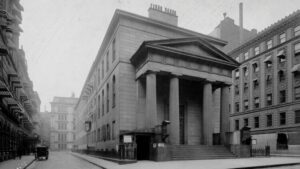
As a case study, we focused on the renovation of 26 Court Street, municipal offices and constituent interaction space for the City of Boston. The project site is notable and historic, as it is the longest continuously owned parcel of land by the City, dating to the 1630’s.
Until 1836, it was the site of the City’s first jail – notably, Captain Kidd’s incarceration in the 1690’s – as well as a setting for Nathaniel Hawthorne’s The Scarlet Letter.
In 1836, Boston Gaol was replaced by a courthouse, which was the site of the successful rescue of Shadrach Minkins from being returned to slavery under the Fugitive Slave Act in 1851, and the failed rescues of Thomas Sims in 1850 and Anthony Burns in 1854.
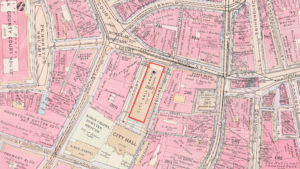
In 1912, the courthouse was replaced by the building that stands today. Designed by architect Edward T. P. Graham, the Boston Landmarks Commission later described it as “one of Boston’s best examples of a public building executed in the Classical Revival style” and determined that the building could be eligible for listing on the National Historic Register.
Although the project did not pursue historic tax credits or landmark status, this public accolade required that we clearly determine our own project renovation goals, both historic and environmental, to maintain the integrity of the architecture.
Our historic goals:
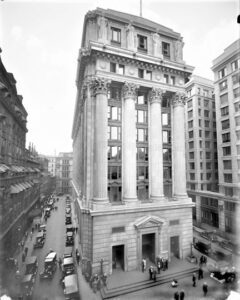
that the interior, which had been replaced in 1968 to be the headquarters of Boston Public Schools, would be gut renovated.
With these goals in place, we were ready to tackle the complexities of the project.

Building systems were transformed, replacing steam radiators fed by gas-fired boilers with a fossil-fuel-free air-source heat pump system.
Replacing the mechanical systems required substantial space that was, of course, not part of the original 1912 design. We needed space for rooftop mechanical equipment which we hid away from the principle, north facade of the building as much as possible. The dunnage for the mechanical system also did double-duty as seismic bracing for the building’s brick parapets.
The floor-to-floor heights, as low as 10’-6”, did not easily accommodate the new mechanical runs, so we designed ceilings with a soffit space marking the transition from the main circulation corridor to open workspace – while also providing space for pipe and duct runs.
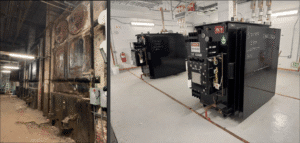
The basement was substantial, having been home to three historic coal fired boilers that served as the original heating system. These were replaced with a vault for two new electric transformers that could not have been accommodated in the typical sidewalk utility vault given the tight urban context.
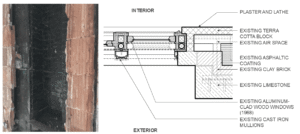
Restoring the historic envelope while making it air-tight and energy-efficient may have been the greatest challenge, as the architecture is representative of a transitional period between mass masonry exterior walls and steel superstructure with masonry cladding. The original composition was limestone cladding, clay brick backup, an experimental asphaltic weatherproofing system – new to buildings of this transitional period – air space for steel structure, and terracotta block to provide fireproofing and a substrate for the plaster finish.
The large air space provided a good opportunity for insulation but required extensive testing to determine material compatibility, with a focus on historic materials that are unusual, such as the asphaltic water barrier; or highly variable in quality, such as the clay brick backup.
Tests included:
This material testing helped us add R-24 of insulation, which was accomplished through a combination of low-carbon closed-cell spray foam and mineral wool, providing an assembly that was both energy-efficient and airtight, while keeping existing materials in place except for the terracotta block and interior plaster finish.
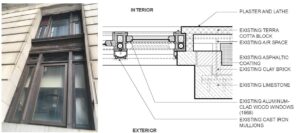
Window replacement for energy efficiency and improved air sealing also presented unusual challenges. We restored the historic cast iron fascias and mullions in place, which necessitated installation of the windows from the interior. The tint of windows replacing historic glazing is also key to restoration. Accordingly, we chose a clear glass with a VLT of 67% with a tint thought to be closest to the historic tint of the windows.
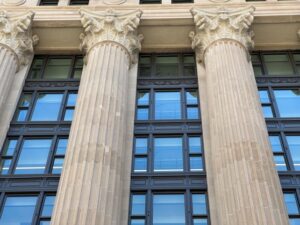
Ultimately, we determined that our renovation of 26 Court Street, including restoration of the façade and reuse of the superstructure, achieved a 69% reduction in carbon dioxide emissions compared with new construction. This environmental achievement could only happen through fossil-fuel-free building systems, an efficient façade assembly, and the long-term utility of a heritage building.
As we continue our commitment to build better using the assets we already have, and to encourage others to preserve and restore our historic architecture, we offer these four key takeaways: